
Project Overview
The Red Springs Project is a large-scale, polymetallic exploration target located in the southwestern area of Jaxon’s 100%-owned Hazelton Property. The project features multiple mineralized zones hosted in tourmaline breccias and sulfide-bearing veins, with consistent grades of silver, antimony, gold, cobalt, and copper.
The centerpiece of the project is the Backbone Tourmaline Breccia Zone, a low-angle thrust-fault-bound sill-like body traced across surface and drill core. This zone extends over a 1 km² area, with surface channel samples returning grades up to 25.9 g/t Au, 0.48% Cu, and 0.5% Bi, and drill intercepts up to 26 meters thick with grades up to 6.6 g/t Au and 0.55% Cu.
Additional mineralized zones include:
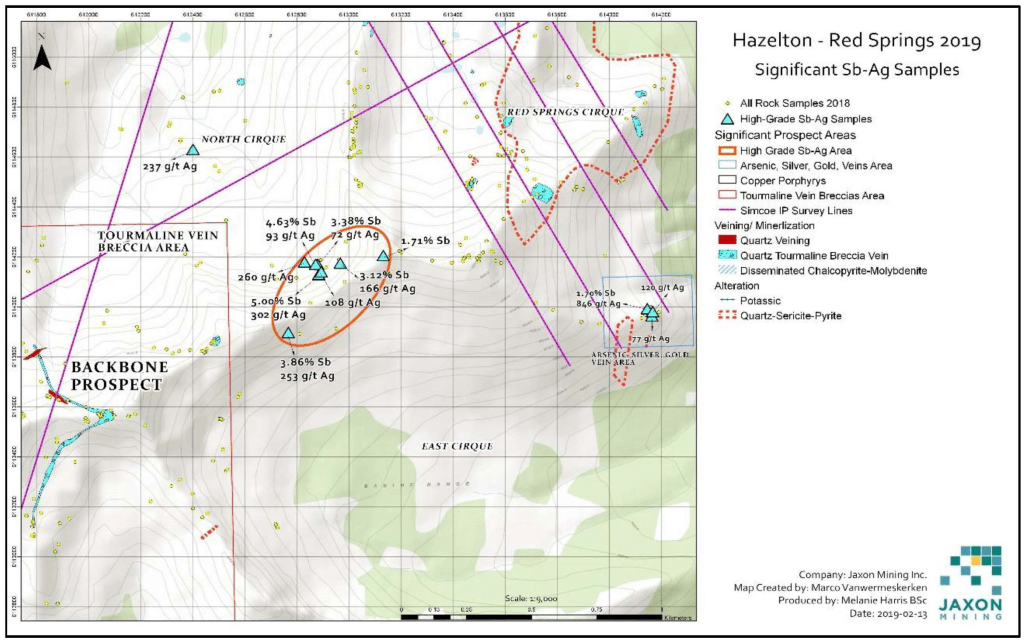
- Sulfide-rich veins in the North and Northwest Cirques, with grab samples up to 848 g/t Ag, 5% Sb, and 8.3% Cu
- Vein-hosted gold-cobalt mineralization, confirmed through surface and drill testing
- Disseminated polymetallic sulfide zones, including quartz-carbonate breccias with silver, antimony, and lead-zinc credits
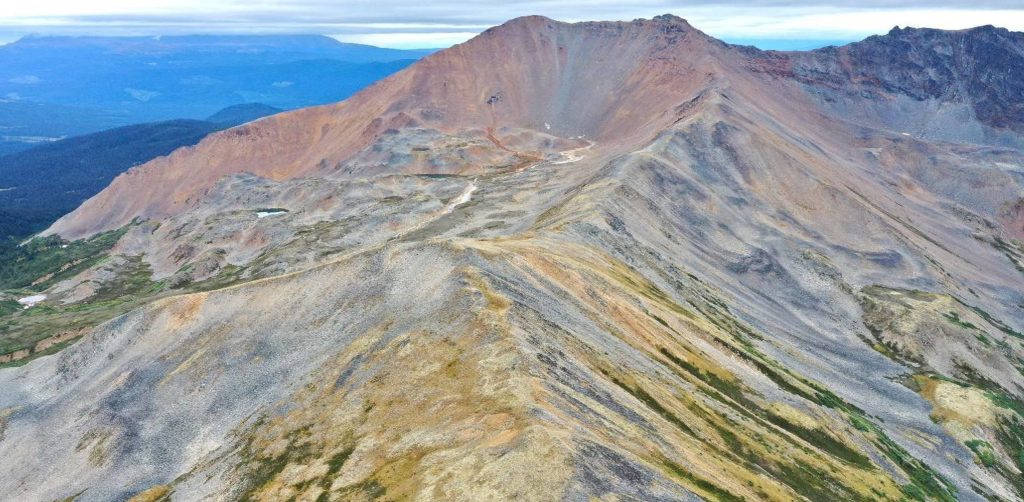
The project area also hosts structurally controlled alteration and veining interpreted to reflect a multi-phase, hydrothermal mineralizing system.

Exploration Work to Date
To date, the Red Springs Project has undergone 1,050 metres of diamond drilling targeting the Backbone Tourmaline Breccia Zone, along with a seven-line, 31 km induced polarization (IP) geophysical survey that identified 16 chargeability anomalies of interest.
A 2 km² ground magnetic survey was completed over the Primary Ridge area, revealing magnetic low signatures interpreted to reflect structural and lithological contrasts. Soil geochemical sampling over 4 km² at Primary Ridge and Razorback outlined multiple multi-element anomalies, including copper, silver, antimony, and gold.
Additional exploration work includes:
- A 12 km² LiDAR topographic survey (2021)
- ~1,200 surface rock samples
- Detailed geological mapping across 30 km²
- Analysis of 50 petrographic thin sections to characterize alteration and mineral paragenesis
Radiometric age dating of intrusive rocks confirms a Late Cretaceous age (approximately 66–67 million years), supporting interpretation of a multi-phase hydrothermal system underlying the breccia and vein-hosted mineralization.
 TSX-V : JAX